Notification System
- the three main types of notifications are push notifications, sms text messages, and emails.
- clarifications.
- notification system should support all three types of notifications mentioned above.
- the system should be as real-time as possible, but we can allow for a slight delay when the system is under high demand.
- notifications can be triggered by client-side applications and directly from the server.
- users can opt-out of receiving notifications.
- millions of notifications sent out daily.
- design.
- to send notifications, we need to store user’s contact information when they download our app or login to our website.
- these can simply be stored in a database, but of course can have standard scaling strategies applied such as database-sharding or database-replication.
- all of our various app services should call a notification service, that is in charge of generating notification payloads that can be sent to third-party providers to actually send emails, texts, etc.
- these notification servers should be able to be scaled horizontally.
- we can use asynchronism and message-queue to decouple our system components temporally.
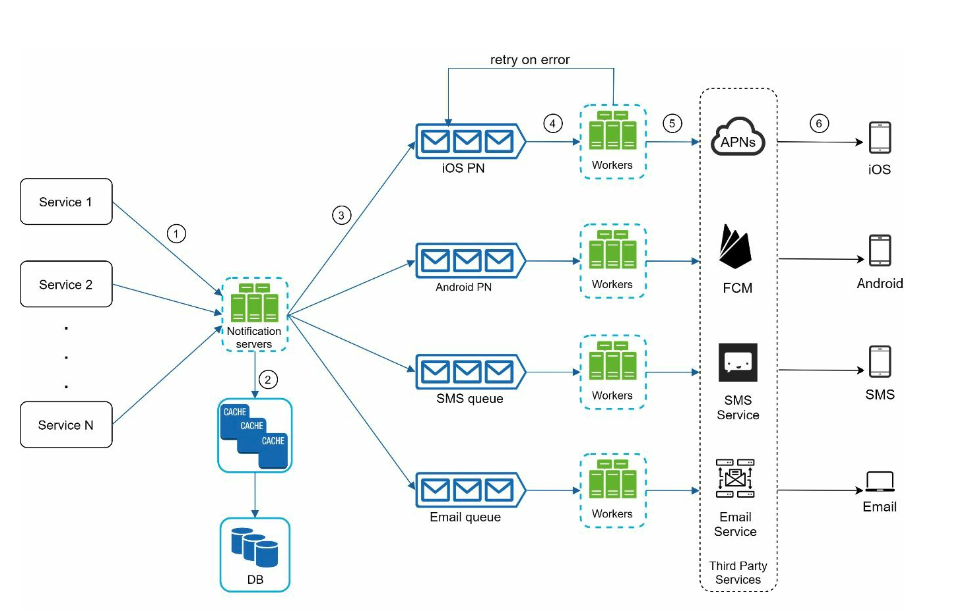
- our various services will call our notification servers through api requests that are only accessible internally.
- deep dive.
- we have to make sure notifications aren’t lost, so we can store notification data in a log database.
- we have unique notification ids, so we can dedupe our notifications in case our distributed system tries to send it twice.
- we can integrate rate-limiter on our side to satisfy our users’ notification settings.
- we could look into keeping track of notification open and clickthrough rate.
- to send notifications, we need to store user’s contact information when they download our app or login to our website.
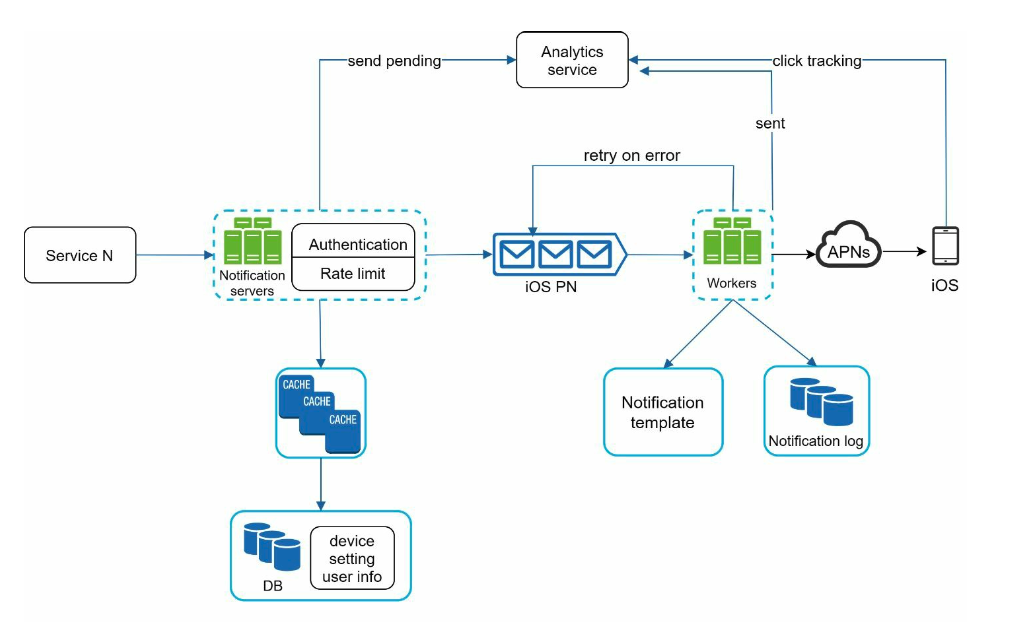
- here’s the diagram now with authentication and rate-limiting in the notification servers.
- we also now have a retry mechanism on the workers and message-queue.
Categories:: system-design