Stores key-value pairs in a long log file, which is appended to when any new data is added.
At its most basic, this kind of non-relational database could be implemented in as little as two bash commands:
#!/bin/bash

db_set () {
	echo "$1,$2" >> database
}

db_get () {
	grep "^$1," database | sed -e "s/^$1,//" | tail -n 1
}
Tip
Updates to a key are also appended! That’s why when we
geta key, we look for the newest instance of that key.
pros
- Writes will always be because all we’re doing is appending to the end of a file.
cons
- Reads become and very slow as the log grows.
- To improve performance, we need to use indexes.
optimizations
- To prevent hash indexes from getting too large and not being able to fit in memory, we can break up logs into fixed size chunks.
- To improve the space and read efficiency of log based storage, we can use compaction and merging.
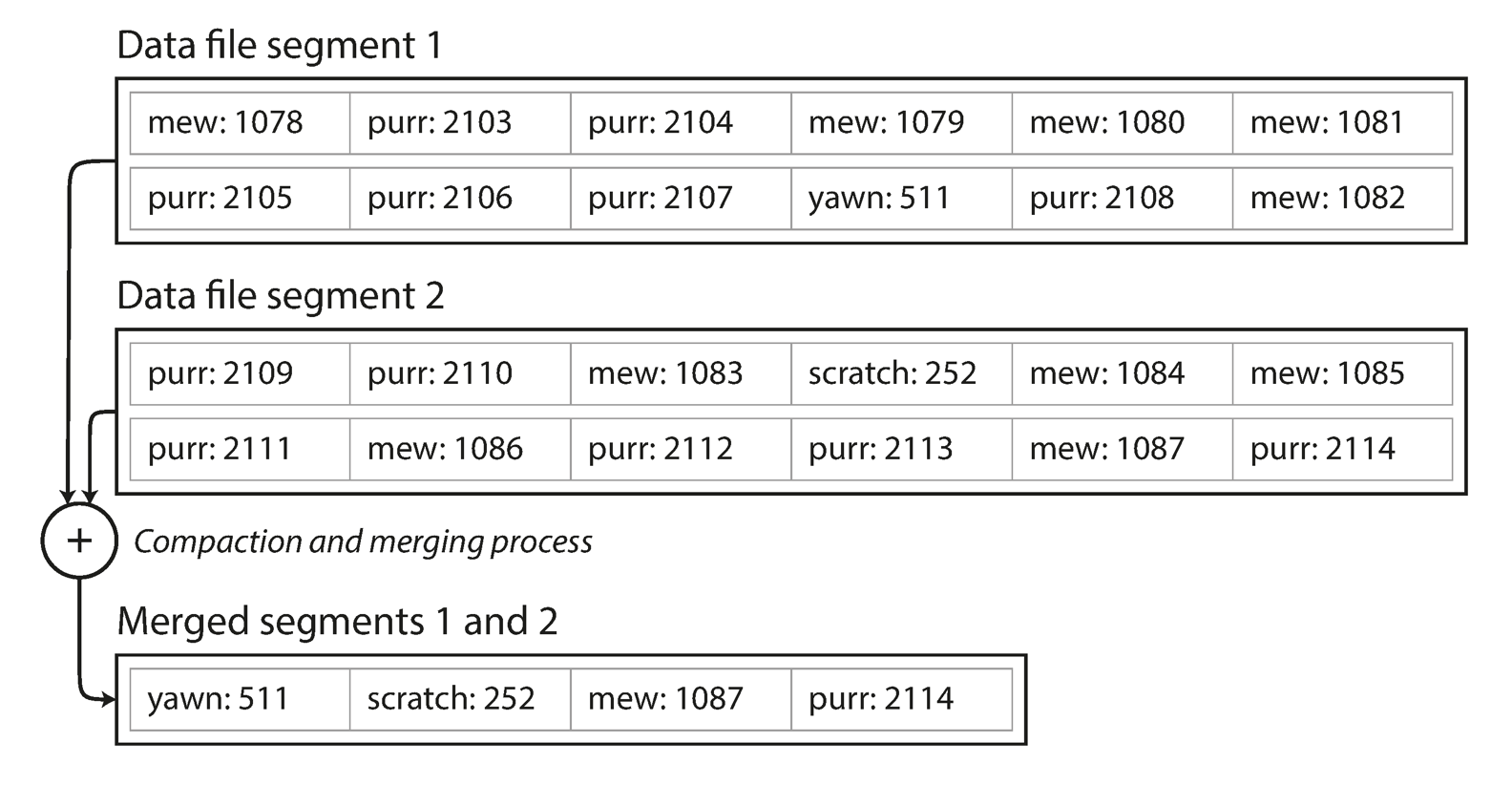
- Compaction is the act of deleting old value of keys in the log that have now been updated.
- Merging is done after compaction, if the newly compacted data from two sections are now small enough to fit in one fixed-size block.