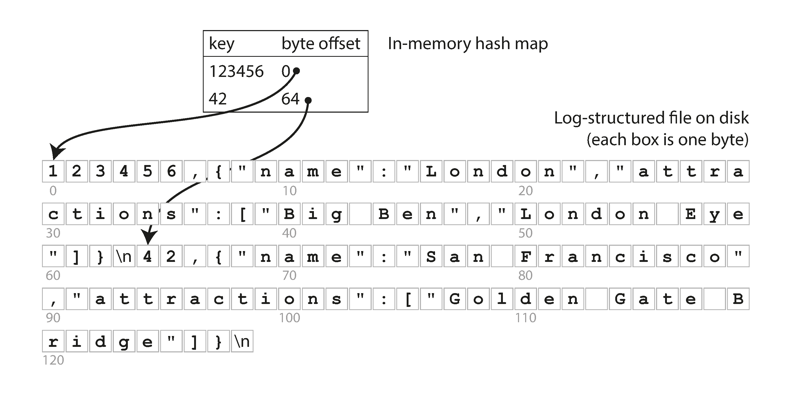
In-memory, we can store a key-value pairs of keys with addresses/data.
hash-index.excalidraw
⚠ Switch to EXCALIDRAW VIEW in the MORE OPTIONS menu of this document. ⚠
Text Elements
“donald”
“shaq”
“jordan”
hash function
3
2
1
donald
shaq
jordan
bird
0xabc
0x209
0xfff
this data isn’t necessarily stored near each other on disk.
Link to original
This allows us to achieve amortized time with lookups in this hash table, pointing us to the address where the data we want to find is on disk.
A word on hashing
Because of hashing, there’s no guarantee that similar keys are close to each other on disk!
pros
- Reads to the hash map are very fast, as they are in-memory and don’t require disk I/O.
cons
- The hash map must be maintained in-memory, because implementing a hash map on disk requires lots of random disk I/O.
- All of our keys need to fit into memory.
- RAM is not durable.
- Range queries are not possible in under time, because the hash map doesn’t implicitly store information about how keys are related to each other (unlike b-trees).