You are given a 0-indexed array of integers nums of length n. You are initially positioned at nums[0].
Each element nums[i] represents the maximum length of a forward jump from index i. In other words, if you are at nums[i], you can jump to any nums[i + j] where:
0 <= j <= nums[i]andi + j < n
Return the minimum number of jumps to reach nums[n - 1]. The test cases are generated such that you can reach nums[n - 1].
dynamic programming
class Solution:
    def jump(self, nums: List[int]) -> int:
        dp = [float("inf")]*len(nums)
        dp[-1] = 0

        for i in reversed(range(len(nums)-1)):
            for jump in range(i+1, min(len(nums), i+nums[i]+1)):
                if dp[jump] is not None:
                    dp[i] = min(dp[i], dp[jump]+1)
return dp[0]- we just keep track of the minimum number of jumps is required to reach the end from index in
dp[i].- our base case is 0 in the final index of the
dparray.
- our base case is 0 in the final index of the
- time complexity, space complexity.
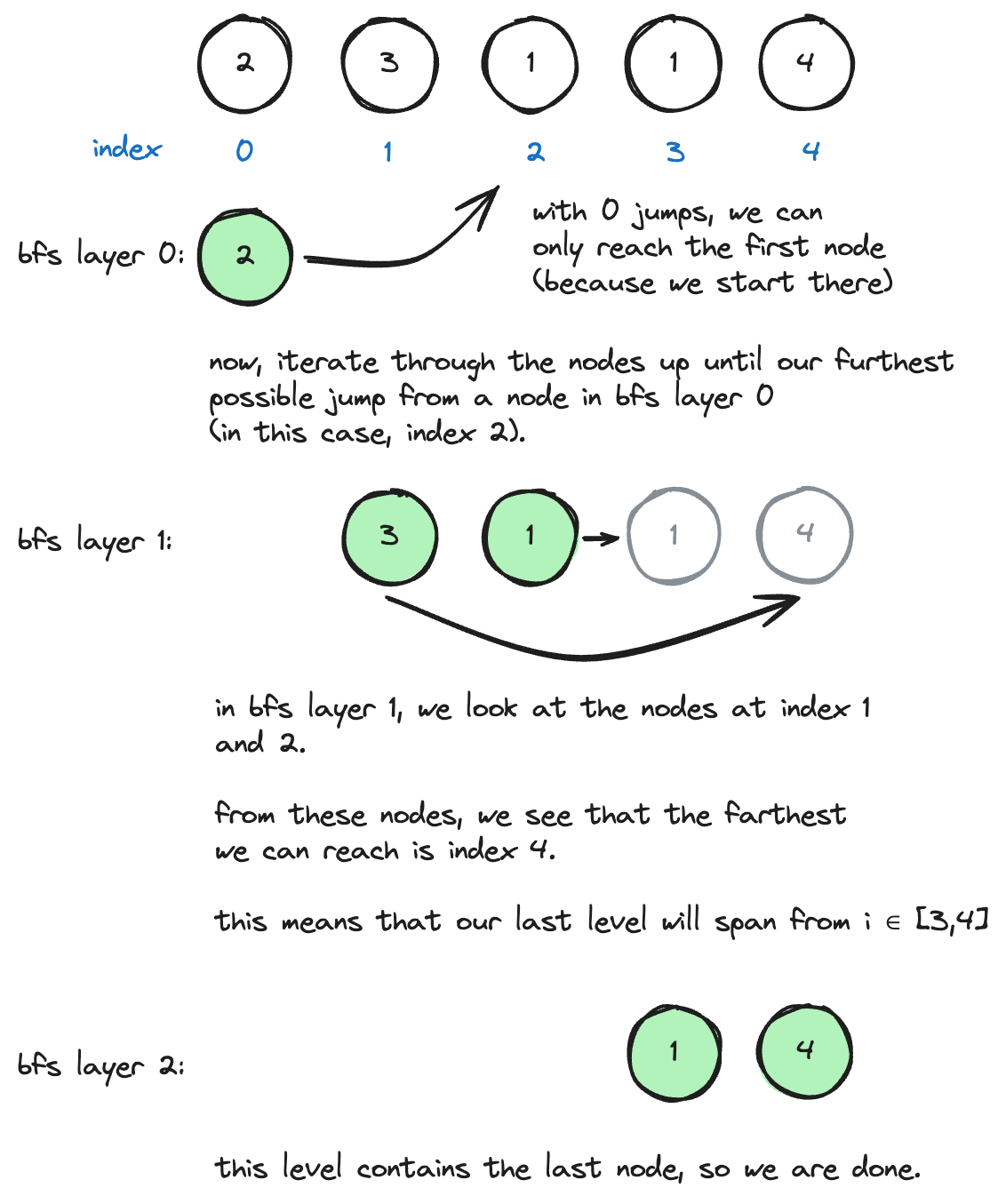
level-order bfs
class Solution:
	def jump(self, nums: List[int]) -> int:
		n = len(nums)
		furthest = 0
		last_jumped = 0
		jumps = 0

		i = 0

		while last_jumped < n-1:
			furthest = max(furthest, i + nums[i])
			if i == last_jumped:
				jumps += 1
				last_jumped = furthest
			i += 1
return jumps- instead of doing dynamic programming, we can instead notice that this problem can be solved as a “shortest path” bfs problem.
- it’s important to note that this solution improves upon the previous solution, to time, because we don’t do any of the repeated work of iterating through all of the possible jumps from each step.
- instead, we just find the farthest possible step that we can reach from each bfs level, which is time per step.