417. Pacific Atlantic Water Flow
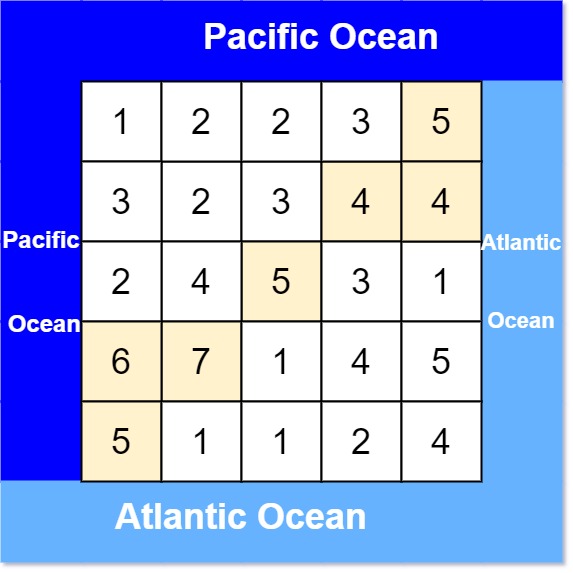
There is an m x n rectangular island that borders both the Pacific Ocean and Atlantic Ocean. The Pacific Ocean touches the island’s left and top edges, and the Atlantic Ocean touches the island’s right and bottom edges.
The island is partitioned into a grid of square cells. You are given an m x n integer matrix heights where heights[r][c] represents the height above sea level of the cell at coordinate (r, c).
The island receives a lot of rain, and the rain water can flow to neighboring cells directly north, south, east, and west if the neighboring cell’s height is less than or equal to the current cell’s height. Water can flow from any cell adjacent to an ocean into the ocean.
Return a 2D list of grid coordinates result where result[i] = [ri, ci] denotes that rain water can flow from cell (ri, ci) to both the Pacific and Atlantic oceans.
class Solution:
    def pacificAtlantic(self, heights: List[List[int]]) -> List[List[int]]:
        mat = [[0 for _ in range(len(heights[0]))] for _ in range(len(heights))]
        def bfs(starting_spots):
            dirs = [[0,1],[1,0],[-1,0],[0,-1]]
            q = collections.deque(starting_spots)

            while q:
                x, y = q.popleft()
                for d in dirs:
                    _x, _y = x + d[0], y + d[1]
                    # bound checks
                    if _x >= 0 and _x < len(heights) and _y >= 0 and _y < len(heights[0]):
                        if (_x, _y) not in seen:
                            # we have to move flat or uphill
                            if heights[_x][_y] >= heights[x][y]:
                                seen.add((_x, _y))
                                q.append([_x, _y])
                                # we've reached this cell from an ocean
                                mat[_x][_y] += 1

        # bfs from pacific ocean
        pacific = []
        seen = set()
        for i, row in enumerate(heights):
            for j, val in enumerate(row):
                if i == 0 or j == 0:
                    pacific.append([i, j])
                    seen.add((i, j))
                    mat[i][j] += 1
        bfs(pacific)

        # bfs from atlantic ocean
        atlantic = []
        seen.clear()
        for i, row in enumerate(heights):
            for j, val in enumerate(row):
                if i == len(heights)-1 or j == len(heights[0])-1:
                    atlantic.append([i, j])
                    seen.add((i, j))
                    mat[i][j] += 1
        bfs(atlantic)

        # go through mat and return all the cells that have a value of 2
        ans = []
        for i in range(len(mat)):
            for j in range(len(mat[i])):
                if mat[i][j] == 2:
                    ans.append([i, j])
return ans- we bfs from both of the coastlines, and if we reach a piece of land while moving uphill from the ocean, then we know that we can flow downhill to both coastlines from this block.
- use another matrix to keep track of if we reach specific cells from both coastlines.
- at the end, return the coordinates of all the cells that have been reached from both coastlines.