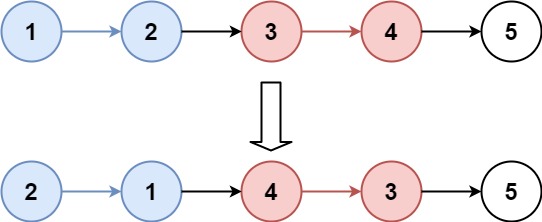
Given the head of a linked list, reverse the nodes of the list k at a time, and return the modified list.
k is a positive integer and is less than or equal to the length of the linked list. If the number of nodes is not a multiple of k then left-out nodes, in the end, should remain as it is.
You may not alter the values in the list’s nodes, only nodes themselves may be changed.
solutions
recursion
- we reverse the first
knodes if they exist, and then connect the tail of this reversed list to the result of the recursive call on the rest of the list.- because of the recursion, we return the head of the entire list at the end of the recursive function.
class Solution:
    def reverseList(self, head: Optional[ListNode]) -> Optional[ListNode]:
        prev, cur = None, head
        tail = head

        while cur:
            nex = cur.next
            cur.next = prev
            prev = cur
            cur = nex

        return prev, tail

    def reverseKGroup(self, head: Optional[ListNode], k: int) -> Optional[ListNode]:
        """
        - reverse the first k elements
        - return the head of the reversed list linked
          to the recursive of the rest of list
        """
        if not head:
            return None

        # find kth node
        cur = head
        # if k is 1, we want to end on the head node
        for _ in range(k-1):
            if cur:
                cur = cur.next
            else: break

        rest = None
        # store rest of list's head
        if cur:
            rest = cur.next

            # disconnect rest of list
            cur.next = None

            # reverse the list
            reversed_head, reversed_tail = self.reverseList(head)

            # link tail to rest of list
            reversed_tail.next = self.reverseKGroup(rest, k)

            return reversed_head

        else:
            return head
iterative
This is less intuitive, but essentially we need to keep track of our previous tail (which starts at dummy), and return the head of the new reversed portion + the next head to reverse from reverse().
Remember to attach the last piece (unreversed) before returning!
def reverseKGroup(self, head: Optional[ListNode], k: int):
	# determine length
	n, curr = 0, head
	while curr:
		n += 1
		curr = curr.next

	def reverse(node):
		prev, cur = None, node

		for _ in range(k):
			nex = cur.next
			cur.next = prev
			prev = cur
			cur = nex
		# prev is rev_head, cur is next piece to access
		return prev, cur

	# dummy -> first_k -> next_k
	dummy = prev_tail = ListNode()
	cur = head

	# by doing this, we don't need
	# to count nodes for every reversal
	for _ in range(n//k):
		rev_head, next_head = reverse(cur)
		prev_tail.next = rev_head
		# cur is now sitting at tail of just reversed k-list
		prev_tail = cur
		cur = next_head

	# connect up last sub-length-k list
	prev_tail.next = cur
	return dummy.next