You are given an integer array nums and two integers minK and maxK.
A fixed-bound subarray of nums is a subarray that satisfies the following conditions:
- The minimum value in the subarray is equal to
minK. - The maximum value in the subarray is equal to
maxK.
Return the number of fixed-bound subarrays.
A subarray is a contiguous part of an array.
solutions
brute force
We can enumerate every possible subarray and check the minimum and maximum in the subarrays.
def countSubarrays(self, nums: List[int], minK: int, maxK: int) -> int:
	n = len(nums)
	count = 0

	for i in range(n):
		for j in range(i, n):
			minv, maxv = inf, -inf
			for k in range(i, j+1):
				minv = min(minv, nums[k])
				maxv = max(maxv, nums[k])
			if minv == minK and maxv == maxK:
				count += 1
	return count
optimization #1
This solution is still enumerating every subarray, but instead of iterating over each subarray in , we instead strategically look at every growing subarray with left bound .
If we ever see a value outside of the valid range, we can stop looking.
Else, if we ever confirm that minK and maxK exist in the subarray, we know that all extended subarrays from will also be valid, as long as we don’t see an out-of-bounds value.
def countSubarrays(self, nums: List[int], minK: int, maxK: int) -> int:
	n = len(nums)
	count = 0

	for i in range(n):
		min_found = max_found = False
		for j in range(i, n):
			if nums[j] < minK or nums[j] > maxK:
				break
			if nums[j] == minK:
				min_found = True
			if nums[j] == maxK:
				max_found = True
			if min_found and max_found:
				count += 1
	return count
optimized - three pointers
The intuition here is a little funky. At the root of it, for these problems where we are looking for “how many subarrays satisfy ”, a trick to avoid overcounting is to consider how many subarrays that end at index satisfy some condition.
We then have to figure out some invariant when constraining the problem to “arrays that end at ”.
For this problem, the constraints are as follows:
- Both
minKandmaxKhave to exist in the subarray, to the left. - No values that are out-of-bounds can exist between
minKandiormaxKandi.
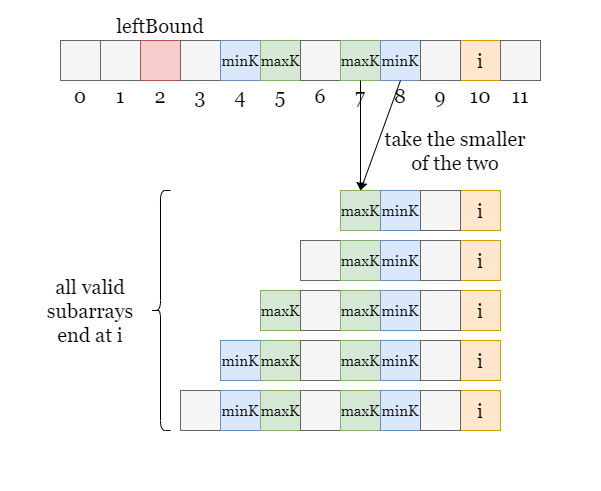
So, this leads us to realize that we need to keep three pointers - the leftmost occurrence of minK and maxK, as well as the rightmost occurrence of an out-of-bounds value.
Then, for subarrays ending at index , we know that we can enumerate the left bound of the subarray to be any index between the previous oob value (non-inclusive) and the leftmost value out of minK and maxK.
def countSubarrays(self, nums: List[int], minK: int, maxK: int) -> int:
	n = len(nums)
	count = 0

	min_pos = max_pos = oob = -1

	for i in range(n):
		if nums[i] == minK:
			min_pos = i
		if nums[i] == maxK:
			max_pos = i
		if nums[i] < minK or nums[i] > maxK:
			oob = i
			min_pos = max_pos = -1
		if min_pos > -1 and max_pos > -1:
			count += min(min_pos, max_pos) - oob
	return count