Given an m x n binary matrix filled with 0’s and 1’s, find the largest square containing only 1’s and return its area.
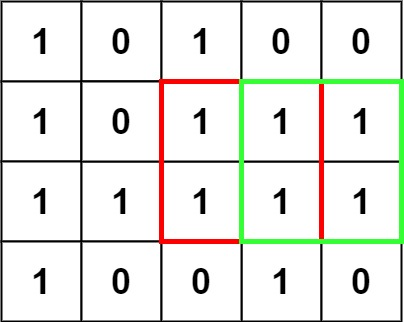
solution
class Solution:
    def maximalSquare(self, matrix: List[List[str]]) -> int:
        """
        - dp is a matrix with the same dimensions as matrix
        - dp[i][j] stores the side length of the biggest one square anchored bottom-right at matrix[i][j]
        - iterate from top-left, going right, then down
        - at each index, check the min square anchored at (i, j-1), (i-1, j), and (i-1, j-1)
        - return max(dp)
        """

        dp = [[0]*len(matrix[0]) for row in matrix]
        best = 0
        # base case bottom row and right column
        for i in range(len(matrix[0])):
            dp[0][i] = int(matrix[0][i])
            best = max(best, dp[0][i])

        for i in range(1, len(matrix)):
            for j in range(len(matrix[i])):
                if matrix[i][j] == "0":
                    dp[i][j] = 0
                elif j == 0:
                    dp[i][j] = int(matrix[i][j])
                else:
                    dp[i][j] = min(
                        dp[i][j-1], dp[i-1][j], dp[i-1][j-1]
                    ) + 1
                best = max(best, dp[i][j])
return best ** 2- pretty cool geometry and dynamic-programming problem.
- we can figure out the maximum sized square anchored at the top corner of some index by looking at the biggest squares that are anchored at the other three quadrants.
221-e1.excalidraw
⚠ Switch to EXCALIDRAW VIEW in the MORE OPTIONS menu of this document. ⚠
Text Elements
length = 1
Link to original - in this example, we see that given the three squares of side length 2, 3, and 4 from the top-right, bottom-left, and bottom-right quadrants, we are able to create a square of side length from our top-left corner.
slight optimization
class Solution:
    def maximalSquare(self, matrix: List[List[str]]) -> int:
        """
        - dp is a matrix with the same dimensions as matrix
        - dp[i][j] stores the side length of the biggest one square anchored bottom-right at matrix[i][j]
        - iterate from top-left, going right, then down
        - at each index, check the min square anchored at (i, j-1), (i-1, j), and (i-1, j-1)
        - return max(dp)
        """

        prev = [int(x) for x in matrix[0]]
        best = max(prev)

        for i in range(1, len(matrix)):
            next_row = [int(x) for x in matrix[i]]
            for j in range(len(matrix[i])):
                if matrix[i][j] == "0":
                    next_row[j] = 0
                elif j == 0:
                    next_row[j] = int(matrix[i][j])
                else:
                    next_row[j] = min(
                        next_row[j-1], prev[j], prev[j-1]
                    ) + 1
                best = max(best, next_row[j])
            prev = next_row
return best ** 2- we only ever need to read the values from the previous row of the
dparray, so we can optimize for space by just keeping track of the current and previous rows.