my solution
meta
- Clarify about what kind of solution we’re looking for.
- I’m going to assume that we want more of a low-level design for how to implement a single vending machine.
overview
A vending machine is a machine that stores various items and allows customers to select them and buy them.
requirements
- Should be able to store inventory for each unique item, keyed by the code that the user needs to enter to select it.
- Should be able to handle an order.
- Be ready for an input.
- After valid input, begin to start accepting money.
- After invalid input, go back to beginning state.
- After accepting enough money, dispense item.
- Handle case when no/not enough money comes for a certain period. Timeout?
- Provide an interface for restocking, where an employee can add items and update inventories.
non-functional requirements
- Consistent/durable.
- A user who inputs a valid amount of money should always get an item out of the machine, unless they walk away without finishing the transaction.
internal design
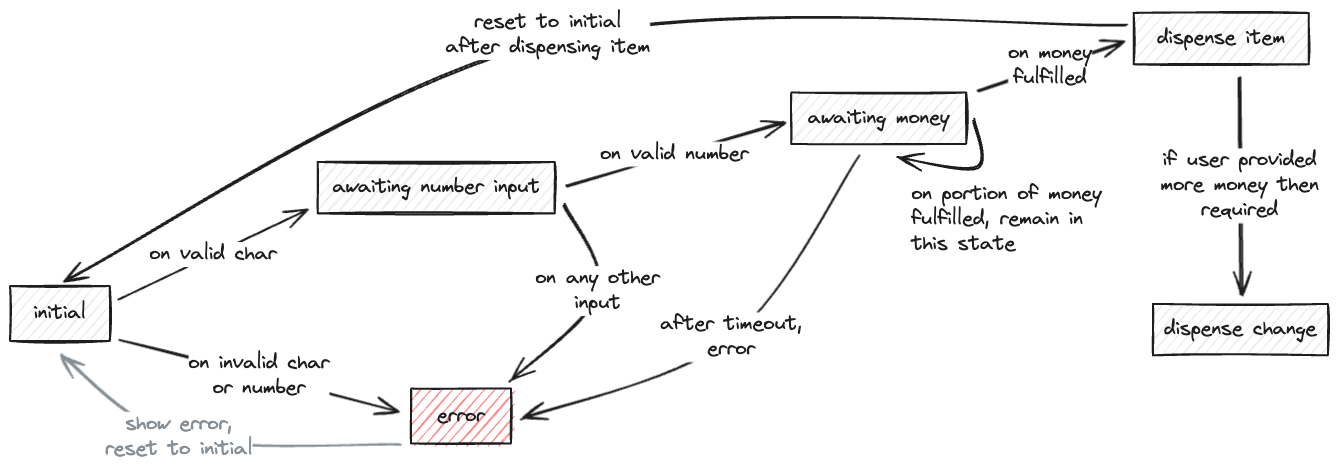
pseudocode
# keypad value or money entered, in cents
type Input = str | int

class State(abc):
	@abstractmethod
	def compute_next_state(input: Input) -> State:
		pass

class InitialState(State):
	def compute_next_state(input: Input) -> State:
		if isinstance(input, str):
			# could be even stricter, probably only
			# a few letters are valid
			if input.isalpha():
				return NumberInputState()
		return ErrorState()

class AwaitingMoneyState(State):
	def __init__(self, cost):
		self.cost_remaining = cost

	def compute_next_state(input: Input) -> State:
		# for simplicity, assume this checks that
		# we are getting a money state
		if instanceof(input, int) and input > 99:
			self.cost_remaining -= input

			if self.cost_remaining <= 0:
				return DispenseItem(itemCode, self.cost_remaining)

			# stay in this state
			return self

class VendingMachine:
	def __init__(self):
		self.inventory = {
			# key: [current_stock, price]
			"A1": [12, 250],
			"A2": [7, 200],
			...
		}
		self.state = InitialState()

	def dispense(self, itemCode):
		self.inventory[itemCode][0] -= 1


def main():
	# always listen for user input
	while True:
		# for simplicity, assume money being added and button presses
		# can trigger this user_input() function
		input = user_input()

		next_state = self.state.compute_next_state(input)

		if instanceof(next_state, ErrorState):
			self.state = InitialState()

if __name__ == "__main__":
	main()