Can the user create custom URLs, or will they always be auto-generated?
How many requests?
100M per month.
functional requirements
A long url should always map to a unique short url, i.e. there should be no collisions.
When a user enters a short URL, our site should redirect them to their original URL.
Our short URL should not be kept in the history stack of their browser.
Short URLs should be persistent.
Custom URLs.
non-functional requirements
Read-heavy system; presumably a short URL is made to be shared, and so we expect many more reads than writes to our servers.
100M write requests per month ~ 40 write requests per second.
Assuming a read heavy system, let’s say 100:1, we can assume 4000 reads per second.
Durability; we shouldn’t lose any data.
Low latency; the user should have as little delay as possible between accessing the short URL and being redirected to their original URL.
Storage: 100M write requests per month, with each storage
api requirements
generateShortURL(longURL) -> shortURL
retrieveLongURL(shortURL) -> longURL
This should be an HTTP GET request that returns a redirect!
data modeling
We don’t need relationships between the links, so we will use a non-relational key-value store type database like AWS DynamoDB.
Each entry will be something like shortURL, originalURL, ...metadata.
Assuming that long URLs are stripped of unnecessary query params, let’s say that each entry is 200B, then we accumulate 100M * 12 * 100 objects = 120B objects.
At 200B each, we get a total storage of 24TB.
high-level design
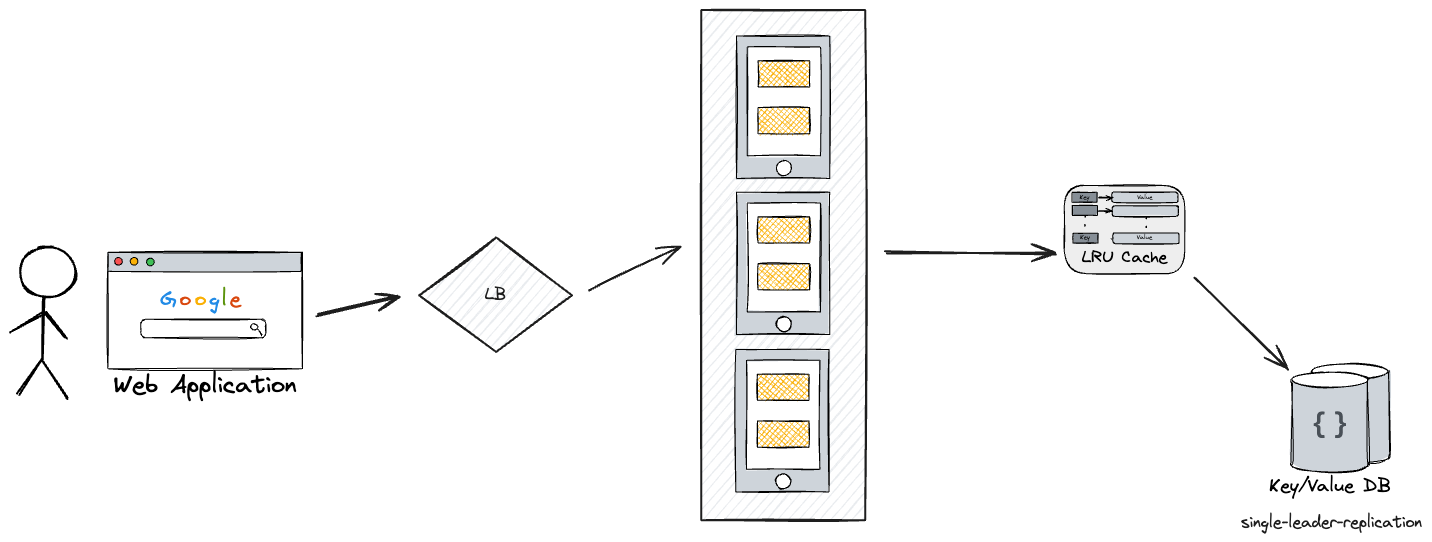
Just a basic application set up, the things of note are:
A load balancer in front of horizontally scaling servers to serve both read and write requests.
A single-leader replicated group of key-value store NoSQL databases to handle high read load.
40 writes/second should be achievable with a single leader node on something like Cassandra.
A cache with something like Redis to store high-traffic keys in memory for fast access and to reduce load on database instances.
An eviction policy like LRU to keep frequently accessed keys in memory.
specifics
How to generate the actual short URL?
Not sure! My two ideas are to either pick the next possible combination, or use some sort of hashing.
With picking the next combination, there could be issues with race conditions when multiple concurrent requests try to grab the “next” combination.
How long should the short URL be? Depends on how many unique combinations we need.
There are 62 unique alphanumeric characters. Having 6 characters gives us 57 billion combinations, 7 characters gives us about 1.5 trillion.
So, we’d probably need to start with 7 characters.
positive feedback
single leader replication was a good idea.
critique
general
I need to start from a simple baseline diagram and only adding things to specifically solve functional/non-functional requirements.
requirements
Didn’t talk about length of short URLs.
Forgot to mention that we need high availability.
design
Didn’t mention partitioning strategies for the database (only replication).
Didn’t talk about replicating/partitioning the caches.
Didn’t talk about exactly how to generate the keys?