You are given the head of a linked list, and an integer k.
Return the head of the linked list after swapping the values of the kth node from the beginning and the kth node from the end (the list is 1-indexed).
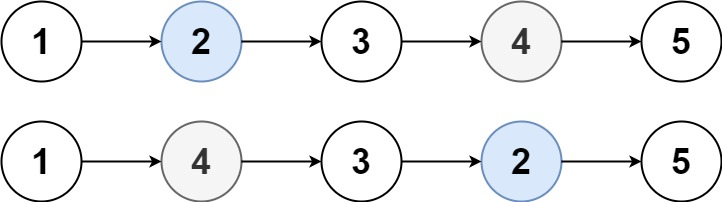
solutions
swapping values
This is what they ask for, and is pretty straightforward with a slow and fast pointer approach.
def swapNodes(self, head: Optional[ListNode], k: int) -> Optional[ListNode]:
	# find kth node and prev of it
	# find kth node from end and prev of it

	if not head.next:
		return head

	fast = head
	# find node k
	for _ in range(k-1):
		fast = fast.next
	c1 = fast

	slow = head # slow on head (1)
	while fast.next:
		slow = slow.next
		fast = fast.next
	c2 = slow

	c1.val, c2.val = c2.val, c1.val
	return head
actually swapping
If instead we need to actually swap the nodes, we can make use of a dummy node to avoid some edge cases, and also store the respective previous nodes for each node we’re swapping.
Note that we need to handle the edge cases where the two nodes are adjacent.
def swapNodes(self, head: Optional[ListNode], k: int) -> Optional[ListNode]:
	# find kth node and prev of it
	# find kth node from end and prev of it
	dummy = ListNode()
	dummy.next = head

	slow = fast = c1 = c2 = p1 = p2 = dummy

	# find kth node and prev of it
	for _ in range(k):
	p1 = fast
		fast = fast.next
	c1 = fast

	# find kth from end and prev
	while fast:
	p2 = slow
		fast = fast.next
		slow = slow.next
	c2 = slow

	# adjacent edge cases
	if c1.next == c2:
		p1.next = c2
		c1.next = c2.next
		c2.next = c1
	elif c2.next == c1:
		p2.next = c1
		c2.next = c1.next
		c1.next = c2

	else:
		n1, n2 = c1.next, c2.next

		p1.next = c2
		c2.next = n1

		p2.next = c1
		c1.next = n2
	return dummy.next