You are given an m x n grid. Each cell of grid represents a street. The street of grid[i][j] can be:
1which means a street connecting the left cell and the right cell.2which means a street connecting the upper cell and the lower cell.3which means a street connecting the left cell and the lower cell.4which means a street connecting the right cell and the lower cell.5which means a street connecting the left cell and the upper cell.6which means a street connecting the right cell and the upper cell.
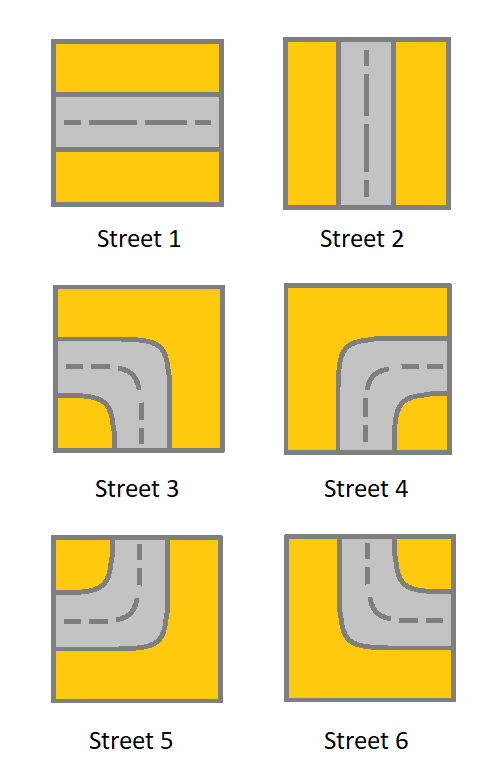
solution
This is basically a spin on a classic “find the path” problem, but we have an extra condition specifying which directions we can enter/leave from each cell.
Create a hashmap to represent those, and by defining dirs in a clockwise direction, we can get the “opposite” direction (e.g. if we exit from the right, we enter from the left) by doing a simple addition + modulo.
def hasValidPath(self, grid: List[List[int]]) -> bool:
	m, n = len(grid), len(grid[0])
	# up, right, down, left
	dirs = [[-1,0],[0,1],[1,0],[0,-1]]

	# valid ingress/egress { grid_type: set(directions connected) }
	connections = {
		1: {1, 3},
		2: {0, 2},
		3: {2, 3},
		4: {1, 2},
		5: {0, 3},
		6: {0, 1},
	}

	visited = set([(0, 0)])
	q = deque([(0, 0)])
	while q:
		x, y = q.popleft()

		if (x, y) == (m-1, n-1):
			return True

		# i is the egress direction
		# (i+2)%4 is the ingress direction
		for i in range(len(dirs)):
			# can't leave through this direction
			if i not in connections[grid[x][y]]:
				continue

			dx, dy = dirs[i][0], dirs[i][1]
			nx, ny = x+dx, y+dy

			if 0 <= nx < m and 0 <= ny < n:
				if (nx, ny) not in visited:
					ingress_dir = (i+2)%4
					if ingress_dir in connections[grid[nx][ny]]:
						visited.add((nx, ny))
						q.append((nx, ny))

	return False